Updated 12 July 2026
"How much is my car worth?" is the first question every seller asks — and the one most people get wrong. Online estimates vary by thousands of dollars, dealers quote low, and it's hard to know what your car is actually worth today. This guide, written by a licensed vehicle valuer, breaks down exactly what sets your car's price in 2026 and how to get a number you can trust.
What decides your car's value
A car's value isn't a single fixed number — it's what a buyer will pay for it today, in its condition, in your market. Seven factors do most of the work:
| Factor | Why it matters | Impact |
|---|---|---|
| Make & model | Reliability, demand and reputation set the baseline | High |
| Age | Value falls fastest in the early years (see below) | High |
| Kilometres | Buyers expect ~15,000 km/year; more = more wear | High |
| Condition | Mechanical health, panels, interior, tyres | High |
| Service history | Proof of maintenance lowers buyer risk | Medium |
| Demand & timing | Season, fuel prices and local popularity | Medium |
| Variant & extras | Trim, transmission, features and colour | Low–Medium |
Impact is a general guide; the exact weighting varies by vehicle.
The first four factors — make/model, age, kilometres and condition — account for the vast majority of the price. Everything else fine-tunes it up or down.
How depreciation works
Depreciation is simply the value your car loses over time. It's the single largest running cost of owning a car — usually far more than fuel or servicing — and understanding it tells you what your car is worth now and when to sell.
As a rule of thumb, a new car in Australia loses roughly:
Depreciation also slows down as a car ages. The difference in value between a 1- and 2-year-old car can be huge; between a 9- and 10-year-old car, much smaller. That's why an older, higher-km car still holds real, quotable value.
Valuation tools compared
Several free tools give you a starting estimate. Each pulls from different data, so it pays to check more than one and treat the result as a range, not a promise.
| Tool | Best for | Keep in mind |
|---|---|---|
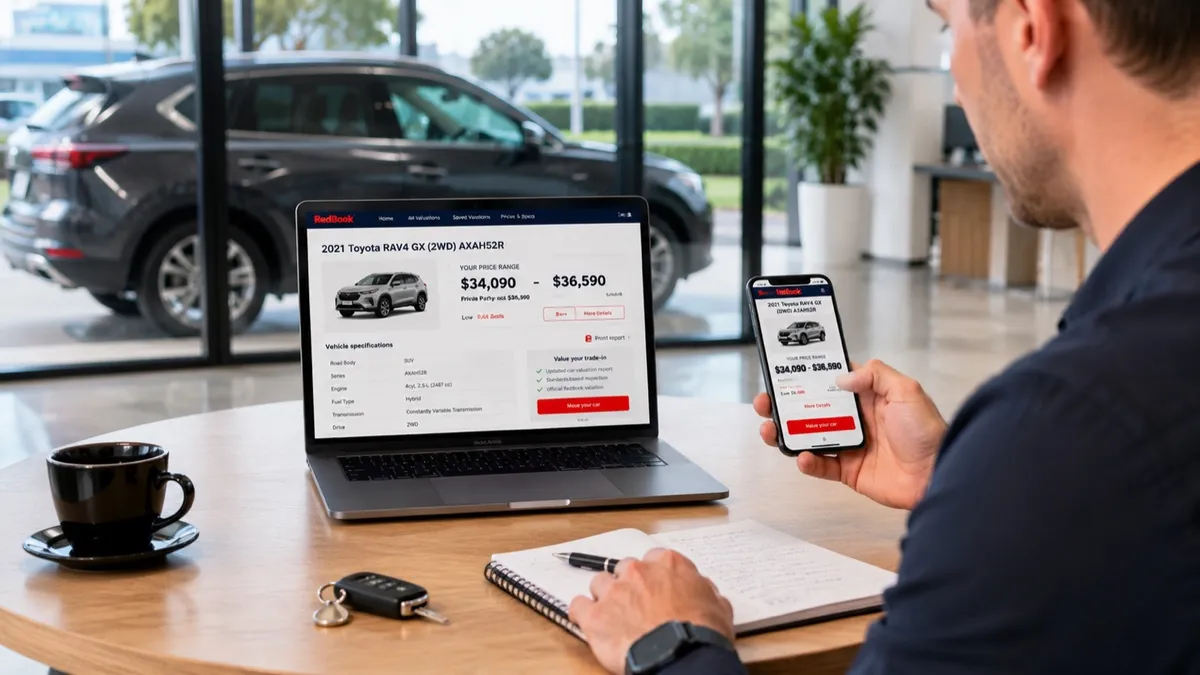
| RedBook | Trade & private price ranges | Averages only — can't see your car's condition |
| CarsGuide Price Guide | Model-level pricing and reviews | Broad ranges; verify with a real quote |
| Carsales listings | What similar cars are actually listed at | Asking prices ≠ selling prices |
| Dealer instant-quote form | A firm, obligation-free offer on your car | The most accurate — based on your real details |
The pattern to remember: online tools estimate, buyers commit. A tool can tell you a 2019 Corolla is worth "$14,000–$17,000"; only a real quote on your Corolla — with its kilometres, service history and condition — tells you the actual number.
Getting an accurate price
Here's the process a professional valuer follows — and the one you can copy to pin down a reliable figure:
- 1
Gather your car's details
Make, model, year, variant, transmission, kilometres and any extras or damage.
- 2
Get 2–3 online estimates
Use RedBook and CarsGuide to establish a realistic range for your exact variant.
- 3
Check live listings
See what comparable cars with similar kilometres are actually listed for near you.
- 4
Get a firm quote
Request an obligation-free offer from a licensed buyer based on your car's real condition.
- 5
Compare and decide
Weigh the firm offer against the effort and time of a private sale before you commit.
Want the accurate number for your car?
Get a free, obligation-free quote in minutes — no guessing.
How to boost your value before selling
A few low-cost steps can measurably lift what buyers will pay:
- Present the service history. Dig out every logbook stamp, invoice and receipt — proof of care reduces buyer risk.
- Clean it properly. A thorough wash and interior detail (a couple of hundred dollars) makes a car far more appealing and photogenic.
- Fix the cheap stuff. A blown bulb, wiper blades or a missing floor mat cost little but signal a well-kept car.
- Find the spare key and manuals. Missing keys are a common (and avoidable) reason offers get reduced.
- Time it well. Demand peaks around the End of Financial Year and over summer.
Frequently asked questions
How do I find out how much my car is worth for free?
Use a free online valuation tool (such as RedBook, CarsGuide or a dealer's instant-quote form) to get a ballpark, then get a firm offer from a licensed buyer. Online tools give a range; a physical or detailed quote based on your car's actual condition, service history and kilometres is far more accurate.
Does mileage really affect my car's value that much?
Yes. Kilometres are one of the biggest value drivers after make, model and age. As a rough guide, Australian buyers expect around 15,000 km per year. A car well under that average is worth more; one well over it is worth less, because higher kilometres mean more wear and a shorter remaining life.
Is my car worth more with a full service history?
Almost always. A complete, stamped or digital service history proves the car has been maintained and reduces the buyer's risk, so it typically adds a few hundred to a couple of thousand dollars compared with an identical car with no records.
Should I trust the first online valuation I get?
Treat it as a starting point, not a final price. Online estimates are based on averages and can't see your car's real condition, extras or local demand. Compare two or three sources and then get a firm, obligation-free quote from a licensed buyer.
When is the best time to sell for the highest price?
Demand is generally strongest in the lead-up to the End of Financial Year (June) and over summer. Selling while your car is 3–5 years old — before it crosses major age and kilometre thresholds — usually gives the best balance of price and remaining value.